S A T O U M I
F O R A N A B U N D A N T
F U T U R E
For a Future Where Economy and Environment Thrive Together
At Satoumi, we believe that climate protection and economic growth are not opposites—they can reinforce each other. Our journey begins with pyrolysis, an emerging yet proven technology that transforms biomass into valuable products such as biochar, bio-oil, and CO₂ certificates, while permanently binding carbon. But this is only the beginning.
In the long run, we aim to establish Satoumi as an innovation hub for future technologies— a place where new ideas for sustainable industry, circular economies, and breakthrough technologies are created, developed, and scaled worldwide. We know we are still at the very start, and that makes the journey all the more exciting. Step by step, we move forward with transparency and humility, guided by a clear goal: To unite economy and environment in a way that makes both stronger together.
Our Approach: Scalable Impact through Collaboration
At the beginning, we will not manufacture the reactors ourselves.
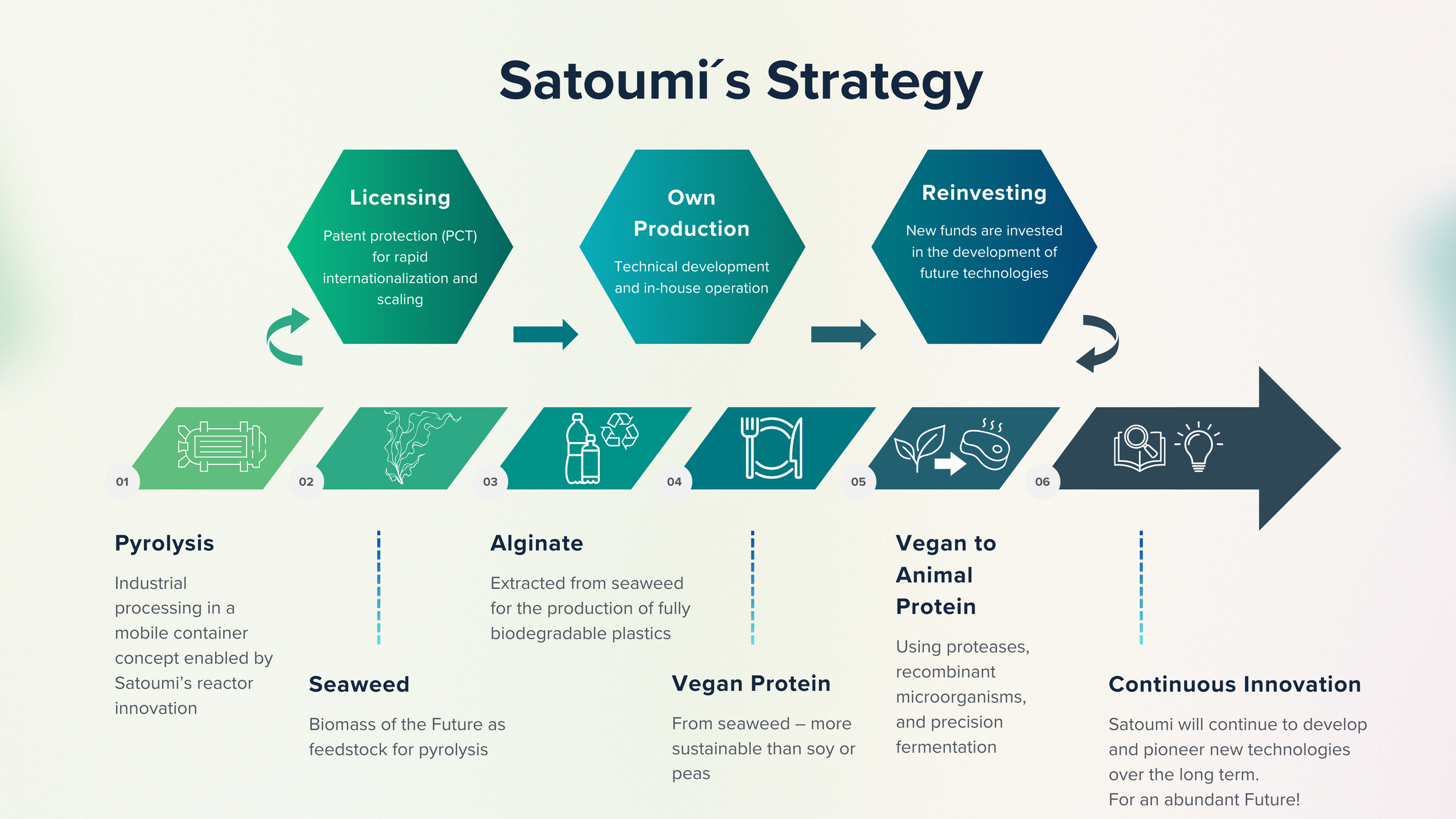
To spread positive impact as quickly and widely as possible, we will license our technology to established pyrolysis companies and projects, giving them access to mobile, efficient, and industrial-scale pyrolysis systems.
This way, we turn competition into customers and accelerate the global adoption of large-scale carbon removal solutions.
Satoumi is impact-driven, not competitive for its own sake. We don’t want to be gatekeepers of technology — we aim to be enablers of change.
Future innovations will follow the same principle:
Patent the technology, license it to others to maximize impact, reinvest revenues into new and improved technologies, and operate selected systems ourselves in specialized markets.
For an Abundant Future.
Medium-Term Vision: Two Pillars – A Network of Possibilities
Future Biomass of the Third Generation
Seaweed (macroalgae) is one of the fastest-growing biomasses on the planet.
It can be cultivated on ropes suspended between floating buoys, growing like a vertical ocean farm without disturbing the seafloor. Seaweed farming requires no arable land, no freshwater, no pesticides, and no fertilizers. In return, it produces proteins, alginates (a key ingredient for truly biodegradable plastics), and captures CO₂ faster than land plants

Seaweed
Pyrolysis
CO2 Removal
Pyrolysis — the thermal decomposition of biomass in the absence of oxygen—it turns organic material into biochar. When biomass decomposes naturally, most of the CO₂ it has absorbed is eventually released back into the atmosphere. Biochar, however, locks carbon in a stable form, permanently removing the CO₂ once captured by plants.
Because of its highly porous structure, biochar acts like a sponge for water, nutrients, and microbes. Applied to soils, it helps increase crop yields, retain moisture, and protect farmland from drought, while contributing to long-term climate resilience.